
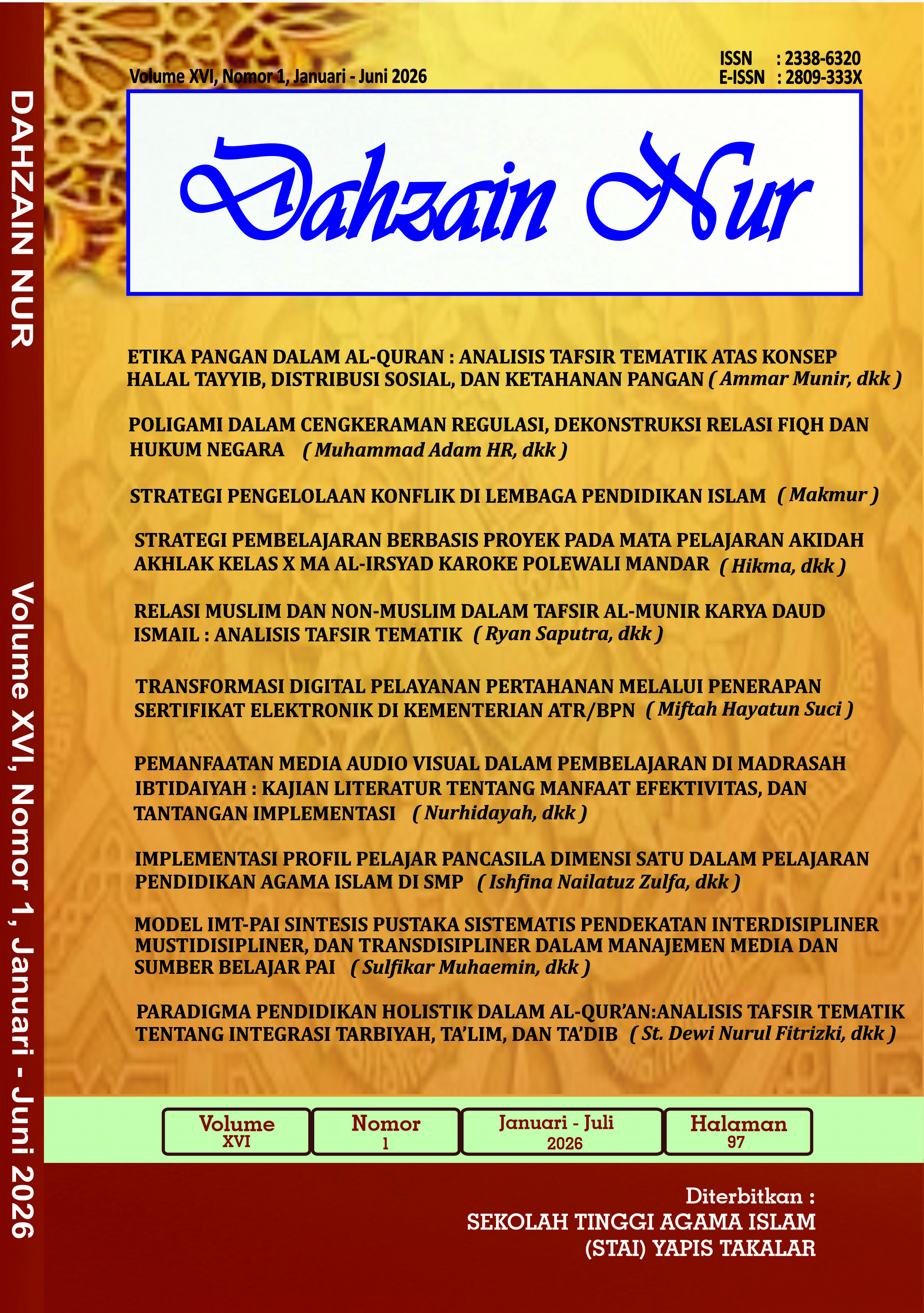
Paradigma Pendidikan Holistik dalam Al-Qur'an: Analisis Tafsir Tematik tentang Integrasi Tarbiyah, Ta'lim, dan Ta'dib
DOI:
https://doi.org/10.69834/dn.v16i1.437Keywords:
holistic education paradigm, Alquran, Thematic Exegesis, TarbiyahAbstract
The dichotomy between education oriented toward knowledge acquisition and character formation highlights the need to reconstruct a more holistic paradigm of Islamic education. This study aims to examine the holistic educational paradigm in the Qur'an through the integration of the concepts of tarbiyah, ta'lim, and ta'dib using a thematic (maw??‘?) Qur'anic exegesis approach. This research employs a library research design, with the Qur'anic verses related to education serving as the primary data source, complemented by classical and contemporary Qur'anic commentaries as well as Islamic education literature as secondary sources. The analysis was conducted through several stages, including the identification of relevant verses, thematic classification, linguistic and contextual analysis, synthesis of interrelated meanings, and interpretation by relating the findings to contemporary educational theories. The findings reveal that the Qur'anic educational paradigm is inherently holistic, integrating tarbiyah as the process of nurturing human potential, ta'lim as the development of knowledge, and ta'dib as the cultivation of ethical conduct and civilized character. These three concepts collectively establish a comprehensive educational paradigm that balances intellectual, spiritual, moral, and social dimensions, making it highly relevant as a foundational framework for the development of contemporary Islamic education aimed at nurturing knowledgeable, morally upright, and civilized individuals.
References
Abdul Hayy al-Farmawi. (1994). Al-Bid?yah f? al-tafs?r al-maw??‘?. D?r al-Fikr.
Al-Attas, S. M. N. (1999). The concept of education in Islam: A framework for an Islamic philosophy of education. ISTAC.
Alavi, H. R. (2019). Islamic education: Teachers' perceptions and practices. Journal of Education and Learning, 8(3), 65–74.
Al-R?z?, F. al-D. (1981). Maf?t?? al-ghayb (32 jilid). D?r al-Fikr.
Al-?abar?, A. J. M. i. J. (t.th.). J?mi‘ al-bay?n ‘an ta’w?l ?y al-Qur’?n (A. M. Sh?kir, Ed.; 24 jilid). Maktabah Ibn Taymiyyah.
Creswell, J. W., & Creswell, J. D. (2018). Research design: Qualitative, quantitative, and mixed methods approaches (5th ed.). Sage Publications
Daud, W. M. N. W. (2018). The educational philosophy and practice of Syed Muhammad Naquib Al-Attas. ISTAC.
Fakhr al-Din al-Razi. (2000). Maf?t?? al-Ghayb. D?r al-Kutub al-'Ilmiyyah.
Fullan, M. (2020). The new meaning of educational change (6th ed.). Teachers College Press.
Halstead, J. M. (2018). Islamic values: A distinctive framework for moral education? Journal of Moral Education, 36(3), 283–296.
Huda, M., Maseleno, A., Teh, K. S. M., Don, A. G., Basiron, B., Jasmi, K. A., Mustari, M. I., Ahmad, R., &
Ahmad, A. (2020). Understanding modern learning environment (MLE) in big data era. International Journal of Emerging Technologies in Learning, 15(3), 4–23. https://doi.org/10.3991/ijet.v15i03.10779
Ibn Kath?r, I. al-D. A. al-F. I. (1999).
Tafs?r al-Qur’?n al-’A??m (S. i. M. al-Sal?mah, Ed.; 8 jilid). D?r ?aybah.
Ismail Raji al-Faruqi. (1982).
Islamization of knowledge: General principles and work plan. IIIT.
Lincoln, Y. S., & Guba, E. G. (1985). Naturalistic inquiry. Sage Publications.
Muhammad Husayn al-Tabataba'i. (1997). Al-M?z?n f? tafs?r al-Qur'?n. Mu'assasah al-A'lami.
Muhammad Quraish Shihab. (2002). Tafsir Al-Mishbah: Pesan, kesan, dan keserasian Al-Qur'an. Lentera Hati.
Qu?b, S. (2003). F? ?il?l al-Qur’?n (6 jilid). D?r al-Shur?q.
Sayyid Qutb. (2003). F? ?il?l al-Qur'?n. D?r al-Shur?q.
Schreier, M. (2012). Qualitative content analysis in practice. Sage Publications.
UNESCO. (2021). Reimagining our futures together: A new social contract for education. UNESCO Publishing.
Zed, M. (2018). Metode penelitian kepustakaan (3rd ed.). Yayasan Obor Indonesia.
Downloads
Published
How to Cite
Issue
Section
License
Copyright (c) 2026 St. Dewi Nurul Fitrizki

This work is licensed under a Creative Commons Attribution 4.0 International License.


